Alternate Physics : Gravimotion Interpretation of Reality
Newton's "inertia law" reveals how "mass" and "kinetic energy", that is energy on the move, make one. The flow of light, which is massless, is also energy on the move.
Energy does not require mass nor its inertia when on the move.
In this gravimotion interpretation, both our human concepts of energy and on the move are combined in the word motion, which unifies both; and a motion has a volume called motion-volume. The word "motion" has a totally different meaning in science physics; for instance it doesn't apply to light waves.
Above all, Einstein "motion" relativity and Newton "motion" laws, are about "speed" and not about motion nor about energy on the move.
Both physics and gravimotion interpretation of Nature fight their ways toward, among other, a common goal that is unification but travel different paths; in gravimotion a particle matter is not made of mass it is occurring at the image of gravity, which is interpreted as stalled motion in the sense of trapped energy.
Topic 1
Topic 2
Topic 3
Topic 4: Explanation of quantum uncertainty, 1935 EPR paper
4 - 1 Introduction to Quantum Mechanics Entangled Pairs.
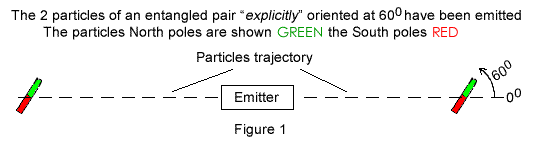
Entangled pairs are made of 2 particles simultaneously emitted by an Emitter in two opposite directions along a common trajectory.
For simplicity, this gravimotion interpretation of Nature deals with particles electrons only; an electron is occurring just as Mother Earth does, spinning around an axis that is defining a specific tilt, an orientation used in this interpretation; an electron may be tilted any value from 1 to 360 degrees. The tilts are counted counter clockwise with respect to the trajectory chosen as reference, and to start with the 2 electrons of any entangled pair are considered identical twins that are having identical tilts.
An electron magnetic axis is represented here with a red/green bar with a small "n" at the north green end. In this interpretation an electron does not have North and South poles; it is the spinning of its electric field that engenders such poles. Figure 1 represents an entangled pair emitted at 60 degrees.
The electrons end up being measured by 2 detectors, called polarizers in science, as shown in Figure 2, and represented here with green/red circles for their South (S) and North (N) poles.
The Left Detector is oriented at ΘLD = 00 (read: theta ell dee) while the Right Detector is oriented at ΘRD = 1200.
When an electron North Pole matches its detector's North Pole as illustrated in the left of Figure 2, the detector flashes a GREEN signal. When the particle's and detector's North pole do not match, as is the case in the Right Detector, a RED signal is flashed.
4 - 2 Human Logic
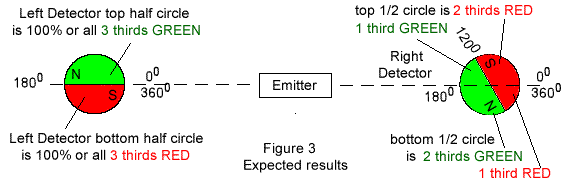
Let's consider a group of 180 pairs in which the two electrons are tilted from 10 to 1800; they are all flashed GREEN by detector A set at 00; yet 60 electrons only are flashed GREEN by detector B, those tilted from 1210 to 1800, while those tilted 10 to 1200 are flashed RED by B.
Clearly 60 over 180 or one third of the pairs flash IDENTICAL GREEN GREEN colors (abbreviated GG in the following) and two thirds flash DIFFERING colors GR.
Because of the symmetry, one third of the pairs flash IDENTICAL colors and two thirds flash DIFFERING colors, when considering the bottom 180 to 360 degrees range.
We, human beings, expect that one third of the pairs will flash identical colors and two thirds differing colors.
This text is in red because the measures provided by the physical experiments do not provide this one third two thirds distribution.
4 - 3 Quantum probabilities
In the early 1900th Quantum mechanics Equation 1 providing statistical information had been set. Should mathematics not be your bag, simply ignore it and jump right down to the paragraph printed in green color below.
Quantum Mechanics Equation 1 provides the probability of pairs yielding the same colors RED,RED or GREEN,GREEN to the pairs yielding differing colors RED,GREEN or GREEN,RED. The detectors orientations ΘLD (read: theta ell dee) and ΘRD can be each given any values from 10 to 3600.
As can be seen the resulting color distribution is independent of the electrons individual angular tilts, which represents a major discrepancy with respect to the previous plain logic interpretation.
When the detectors angles are set at ΘLD = 00 and ΘRD = 1200, as shown in both preceding Figures 1 and 2, Quantum mechanics (Equation 1) predicts that same colors (either GREEN GREEN or RED RED) will be flashed one-quarter of the times, instead of one-third of the time, and opposite colors (either RED GREEN or GREEN RED) will be flashed three-quarters of the time, instead of two-thirds of the time.
This text is in green because the measures provided by the physical experiments precisely provide one quarter of the entangled pairs flashing same color, three quarters differing colors, when the detectors are set 1200 apart.
In Quantum mechanics, the 2 particles of any entangled pair while emitted simultaneously in 2 opposite directions, are identical twins or some say complementary; more explanation on the subject is provided later.
Then, no matter the epoch, no matter the country, no matter the time all entangled pairs occur under a unique format shared by all pairs.
Amazingly this universal format, called Quantum State is made of a number of incompatible occurrences; for instance a Quantum State may group at same time the 2 incompatible states the particle exists and the particle does not exist, which mandates uncertainty to prevail at Quantum scale (that is infinitesimal distances).
Finally, in Quantum mechanics, the particles lose their uncertain state when physically measured; their newly acquired physical entity when measured provides a definite measure such as NORTH or SOUTH, or depending on the settings an ON or OFF, or the particles may flash a GREEN or a RED light; in the Quantum world there are no other alternatives such as SLOW or FAST in between ON and OFF; in case of colors there cannot be any BLUE, YELLOW, WHITE or BLACK besides GREEN and RED.
4 - 4 Scientific Discord
Clearly Quantum Probabilities contradict Human Logic.
By 1935 no experiments were run and whether Quantum Probabilities or Human logic would rule was still unresolved.
That year Einstein, Podolsky, and Rosen, in a paper now referred as EPR, demonstrated that should Quantum mechanics prevail, hidden variables were underlying Quantum Probabilities.
Almost thirty years later in 1964 John Stewart Bell in a disclosure now called Bell's inequalities (see also Bell's inequalities for everybody) very surprisingly demonstrated that should physical experiments confirm Quantum Probabilities, no plain logic would ever explain the phenomenon. In effect contradicting EPR.
Two discordant schools of thoughts appeared in science; One based on Quantum Probabilities and another simply rejecting it.
Alain Aspect experiments in the 1980's definitely justified Quantum Mechanics theory.
Now popping out of the measures and defying logic these Quantum Probabilities can only be rationalized considering instantaneous interactions over long distances, contradicting Einstein's well established relativity which states that no interaction over distance can occur faster than light.
And, because no explanation can explain these results until the measures do occur, uncertainty has to rule at Quantum scales.
All in all in science at Quantum scale non-locality and uncertainty are ruling. Yet despite Bell's theorem, EPR's hidden variable, because proven mathematically, must be acting in the background...
4 - 5 Hidden Variable
BEWARE, at time of this writing, the following language and equation is denied by most professional physicists; yet this gravimotion entanglement interpretation while concurring with science's mathematics is only challenging science's psychological interpretation of it. Should mathematics not be your bag, simply ignore Equation 2 and jump to the paragraph printed in green color below.
Equation 2 below, while concurring with Quantum probabilitiesEquation 1, brings to light the individual behavior of each particle, as predicted by EPR yet banished by Bell's theorem.
Provided the pairs are evenly distributed when emitted, those tilted between 10 and 1350 represent three quarters of those tilted between 10 and 1800. The remaining 45 pairs between 1350 and 1800 make the remaining quarter. And due to symmetry an identical distribution applies to the other 1810 to 3600 half of the spectrum.
In order to match the physical measures and Quantum Mechanics statistics when the detectors are set 1200 apart, it suffices to come up with an equation that modifies the pairs tilted between 00 and 1350 to angles tilted between 00 and 1200. Equation 2 is just doing that:
When the detectors are oriented 1200 apart as in Figures 2 and 3, the particles evenly tilted from 00 to 1350 when emitted will be, according to Equation 2, deflected and measured between 00 and 1200 by both Detectors; these explicit deflections precisely coincide with the physical measures and Quantum mechanics statistics.
This explicit interpretation is written in green because it is in agreement with both experiments and Quantum Mechanics probabilities.
In this interpretation the 2 particles of any pair are acting in concert with Quantum probabilities, not because one side is instructing the other to comply instantly over distance, but because at the very time the measures take place, each and all electron tilts are individually and precisely deflected in the amount provided by Equation 2.
Gravimotion's Cyber Experiment shows that both left and right detectors are each behaving independently of each other in accordance to universal rules; and that occurs no matter the reference chosen by us human beings for our human interpretation; as such any reference other than the trajectory, as introduced in preceding Human Logic page, may be chosen.
Let us choose the ΘRD right Detector angular orientation for reference; ΘRD being now null:
Equation 3, a derivative of Equation 1 hidden aspect shows that detectors' orientations just as electrons' tilts can be re-oriented in order to describe the entanglement phenomenon.
Equation 3 modifies θDetectorNominalOrientation = 1200 into θDetectorEffectiveOrientation = 1350 and θDetectorNominalOrientation = 00 remains unchanged at θDetectorEffectiveOrientation = 00.
In these conditions one quarter identical measures instead of one third identical measures will occur, provided the emitted electrons are evenly distributed over the full 3600 circumference.
4 - 7 Tacit entanglement
Quantum Mechanics Equation 1 is dealing with the detectors angular difference, in effect that difference is entwining the 2 detectors angular orientations in one entity, unconditionally mandating instantaneous interaction altogether abrogating distance.
In gravimotion's interpretation of Nature, the 2 detectors are instead located far away from each other, are independently set and are independently measuring the entangled particles.
All in all the 2 detectors' physical distant separation is incompatible with Quantum Mechanics inextricably entwined angular difference.
In short Equation 1 inconsiderate use of the detectors angular difference is at the origin of the conflict.
Let's face it, such angular difference is not a physical entity, it actually is occurring as 2 specific orientations of 2 specific detectors far apart from each other; and that can no longer justify uncertainty and non locality.
Nevertheless Quantum Mechanics Equation 1 probabilities mend nicely with local reality.
The two detectors MIRROR IMAGES of each other, because SET 120 DEGREES APART, are behaving in concert as if they were physically connected. Note that this tacit behavior interpretation turns out to be complying with Quantum Mechanics non-locality.
Yet the pairs' two particles COMPLEMENTARY state is also acting tacitly on each side of the emitter over distance just as if the 2 particles were connected through a physical rod playing the role of instantaneous communication between the two.
These just mentioned 2 behaviors are now individually acting in concert with each other, on each side of the pairs' emitter, no matter the distance. This distant tacit collaboration is now justifying EPR's hidden variable.
When the detectors are set 120 degrees apart, Quantum Mechanics stipulates that only an infinite number of pairs emitted will provide the 25% 75% distribution.
The Cyber Experiment proposed here reveals that 3 essential factors are actually at play:
The number of pairs must be a whole of 8.
The particles' angular orientation must be evenly distributed over the entire 360 degrees spectrum; as such the number of pairs to be emitted can be 8, or 16, or 24, or 32 up to an infinite number, the latter only being considered in Quantum Mechanics theory and experiments.
Should one choose to emit 24 pairs, the pairs should be separated 15 degrees from each other; such details, even though essential, are totally ignored in Quantum Mechanics.
And as mentioned above the pairs' complementary aspect is of the essence.
The computer simulation labeled Cyber Experiment reveals that this complementary factor may be interpreted either as the 2 particles of any pair being emitted at 180 degrees from each other or the two particles being emitted with identical orientation.
When complementary pairs are emitted 3 quarters flash the same colors 1 quarter differing colors. When twins are emitted 1 quarter flash identical colors 3 quarters flash differing colors.
All pairs' configurations that are neither complementary nor twin fail to provide the 1 to 3 quarters distribution.
Yet all of the above is not what creates the 25%, 75% distribution; such specific distribution is entirely dependent on the deflection of the particles. Or besides all of the above, which is mandatory, the particles' deflections (called diffraction in science) are the cause behind the observed phenomenon.
In addition the Cyber Experiment proposed in this application disclosed another result usually not mentioned in science; the 25% 75% distribution is also occurring when the detectors' orientations differ by 60 degrees, 240 degrees and 300 degrees.
Per definition uncertainty ecades all explanation.
Mother Nature's precision, beauty-fullness, and let's face it sly behavior regarding these entangled pairs is flabbergasting ... Her Magnificence had to be uncovered ...